
Written by Macy Aurilio
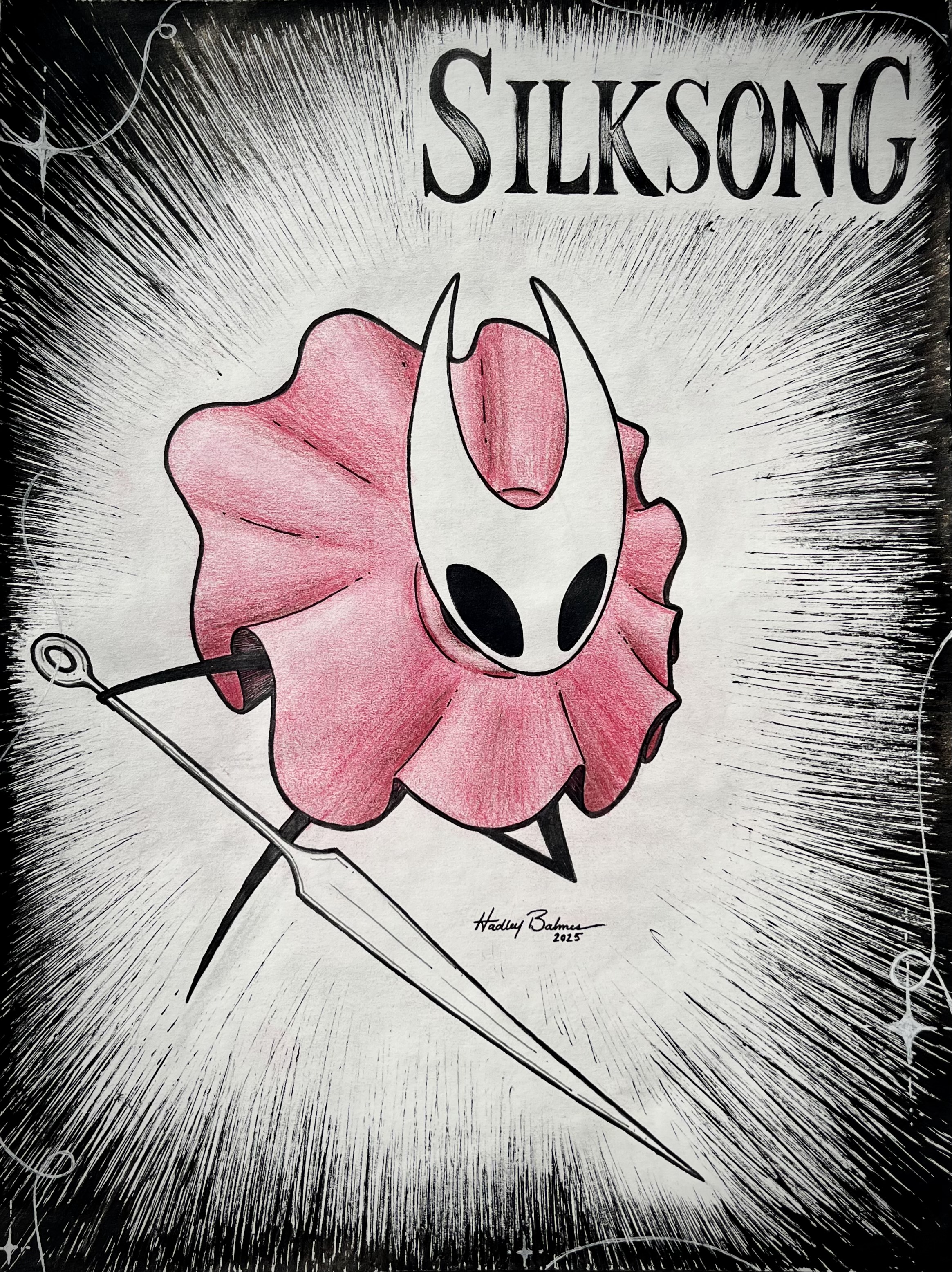
Art by Hadley-Rae Balmes
When Hollow Knight joined the indie game hall of fame in 2017, it fit right in alongside Cuphead and Undertale with its cute characters and overwhelming bosses. It was an immediate success, met with critical acclaim, over 15 million copies sold across platforms as of 2025, and inspired countless indies to follow. I don’t need to say how much of a win Hollow Knight was for its tiny development studio, Team Cherry. The process that went into its sequel, Silksong, speaks to it perfectly. Minimal teasers and updates had Hollow Knight fans confused and anxious over its seven years of development, and they were dumbfounded by how Team Cherry justified their lengthy work period—they were “just having fun.” They were enjoying building Silksong so much that they didn’t want to stop. And with the immense support of fans and Hollow Knight‘s financial success, they didn’t have to stop developing for a very long time. This phenomenon has been referred to as “development heaven,” a pleasant contrast to the more common experience, “development hell.” Silksong‘s long-awaited release hasn’t been without criticism, but the vast majority of players, old and new, can feel the love and joy that went into its development.
Without being exceedingly difficult, Silksong’s early bosses offer a fair challenge to a player still acclimating to its new controls. The beloved princess-knight Hornet has returned in Hollow Knight‘s sequel, this time as a protagonist, and she has a variety of tools and skills at her disposal—many of which aren’t available until a dent has been made into the game’s runtime. These abilities expand on combat and exploration, and restructure inventory capacity. Some are optional, and some can’t be missed. But these upgrades aren’t intended to turn the game into a power fantasy, even when they do provide considerable advantages. As the breadth of Hornet’s talents widens, so does the challenge offered by her enemies.
Hornet’s moveset has quite a few differences from what Hollow Knight fans are used to. One of the most important moves for both combat and exploration in the first title was the “pogo,” performed when a player slashed downwards, allowing them to bounce off of enemies or obstacles below them. The infamous “Path of Pain” was one of many areas in Hollow Knight to require extensive and precise usage of the move, where a slight misinput may result in a significant loss of progress. Silksong doesn’t exactly remove the pogo, but does fundamentally change it. When a player attacks while holding the downward directional input, rather than striking what is directly below it, Hornet dives in a diagonal dash towards the right or the left, depending on the player’s input. This small change encapsulates the ideology present in Silksong’s developments and changes to its predecessor. Rather than sweeping changes to foundational mechanics, Team Cherry has adjusted preexisting functions to create a different experience, one familiar to Hollow Knight players that simultaneously provides new systems to learn and master. The diagonal pogo changes how a player approaches enemy encounters and exploration by introducing a lateral aspect to coordinate alongside the vertical movement already present. It makes sense; if the mechanics used in Hollow Knight aren’t broken, why fix them? Team Cherry instead opts to build on and tweak these parts of gameplay, keeping all that goodness from Hollow Knight while giving it a new, distinct flavor—it’s hard to improve on such an airtight experience, but not impossible!
Another one of the many differences between Hollow Knight: Silksong and its predecessor is the parry. Dive or slash at just the right time, and your enemy will be open for a hit—fail, and your blade clangs against your opponent’s sword, shell, or claw, flinging you back. While many of the bugs of Hallownest (the primary location of the events of Hollow Knight) will simply crawl or fly along as you waddle up and slash through their carapace, the same is not true of Silksong’s Pharloom.
An early game fight sees Hornet facing off against Lace, a sword-wielding humanoid creature in a world of loosely anthropomorphized insects. In previous encounters, bugs twice Hornet’s size might slam their bodies down on her head or fire hordes of projectiles off in her direction. Lace instead meets Hornet’s own skills with her blade, using a comparatively delicate fencing technique. Her fight is fast, fluid, rhythmic, and aggressive, as both bugs trade quick attacks and dodge one another’s moves. Hollow Knight was frequently praised for its boss fights, which drew the player into the hard-sought “flow state,” where a player is so immersed in gameplay that they operate fully in sync with game mechanics. Lace is a less oppressive example of this phenomenon in action, where the challenge is evenly met.
I’ve been asked by current players whether I think Silksong is easier than its predecessor or not, and while I’m tempted to say yes, it’s important to consider that I have extensive experience with Hollow Knight, and even though Silksong controls differently, I have a considerable head start. Having familiarity with the basic mechanics will absolutely make the early game easier. Which is not to say it’s a beginner-friendly game, but it also isn’t beginner-unfriendly. I don’t think that means someone has to have played the original to enjoy the sequel. I’m actually in the opposite camp. While it’s painful to imagine there are people who haven’t played Hollow Knight, aside from spoiler-related concerns, I really wouldn’t have a problem recommending Silksong to those people. It teaches the player the basics and allows someone unfamiliar with Hollow Knight to explore without additional difficulty. Although I recognize my own bias, I would still say the first few hours of Silksong are just a touch easier than the first title—bosses are a little more forgiving, and exploration a little less tricky. Rest assured, though, experienced players should feel more than enough challenge by the time they meet the act-closing boss. (Yes, there are acts, but I’m not saying how many.)

In Team Cherry’s first title, the name of the game was overcoming challenge. Boss fights (and even simple enemies) in Hollow Knight could feel insurmountable, brick walls that offered no give, even in multi-hour play sessions. While the fights with this description typically took place towards the end of the game, or even as post-game optional challenges, they were highly encouraged in an experience that rewarded repeated attempts and curiosity. After defeating a particularly harrowing boss in Hollow Knight, the player could set down their controller (or lift their hands from their keyboard) and breathe a sigh of relief, each victory proof of a sentiment that quickly became personal: you can do difficult things.
If I were to describe Silksong as less challenging than its older sibling in its entirety, I’d be making fun of myself and my embarrassing number of attempts on several early-game bosses. But it is different in a way that might be difficult for players to describe. Pharloom’s residents are enemies suited for any number of combat styles Hornet may employ, and designed to keep combat engaging, striking a balance between the oppressive superiority of Hollow Knight’s bosses and a more player-friendly experience.
Effectively, the difference between these games reflects the narrative playing out in each. In Hollow Knight, the player operates a little bug with no voice, no personality, and no independent strength. Within the story, this is intentional and more than necessary. To vastly simplify, the player character intends to take on a burden that requires a vessel completely devoid of soul, free will, beliefs, dreams, or intentions. Fights in Hollow Knight fittingly make you feel like a small bug in the jaws of a giant monster, but they do so in service of that theme: to make you feel like nobody, which only enriches the feeling of triumphing over those challenges.
Silksong functions differently. Hornet speaks for herself, makes her own decisions, and directs the player in a way the previous protagonist was incapable of doing. As a player, it’s incredibly refreshing to spend so much time with a character who we know has a strong will and sense of self from the previous title. For as much as Silksong’s challenges may initially be easier than Hollow Knight’s, there’s something in how they grow with you that keeps a player invested, that ascribes some value to the player through their play. Getting better at any game is a reward for working hard to learn new skills.
The similarities between Silksong and its predecessor will be apparent to those who play both. From the basic mechanics to the more specific, several elements are lifted and only slightly changed to better fit the tone, themes, and story of the new game. How the player obtains a map for a new area is a perfect example. The process is the same: upon entering an unfamiliar space, within a few rooms of the entrance, a player will encounter the long-nosed mapmaker Cornifer in Hollow Knight, or the singing warrior Shakra in Silksong. The function of this NPC is to provide the player with access to a map and a few other helpful materials for exploration, a necessary thing in both titles. But side-by-side, both characters can be seen as only fitting in their respective games. Cornifer is a friendly bug, but one who isn’t particularly concerned with the protagonist, lost in his own passions and terrified of the surrounding enemies. A throughline with Hollow Knight‘s characters was just that—lack of direction, or will, or awareness, being lost in one’s obsessions. Shakra, however, is built to mirror Hornet: a talented female warrior, making her own way through a foreign land in search of her missing leader, fiercely independent but ultimately focused on connecting with her companion. And while Hornet isn’t initially aware of it, she’s on the same path of reuniting with lost kin.
As the player navigates Pharloom’s tunnels and towns, they’re likely to notice how different its contents are from Hallownest’s. For one, the civilizations are much more populated, and NPC interactions generally feel more fleshed out due to Hornet… actually speaking. Where Hollow Knight‘s protagonist was silent and unresponsive, every conversation teaches the player something about Hornet: where she comes from, what she believes, and what she has experienced before we began to control her. Pharloom’s occupants all live under the oppressive claws of the Citadel and its caste system. Bugs on something of a religious pilgrimage fight to reach the top of the Citadel, braving the hostile landscapes and enemies. Silksong‘s religious themes extend to each of its major game systems: rosary beads act as the currency of Pharloom, Hornet is assisted by pilgrims devoting themselves to the Citadel, and enemies are tools (or sometimes victims) of the forces at the top of the system. And each of Pharloom’s residents seems singularly obsessed with a peculiar object: bells.
Opponents throw bells at you as projectiles. Benches, Hollow Knight‘s method of saving and restoring health (think of Dark Souls‘ bonfires), are shadowed by massive bells. In order to progress past the first act, Hornet must locate five bells scattered across the map that cause the entire room to vibrate when rung. Where in Hollow Knight the player could quickly travel from one area to another through the assistance of a friendly NPC called the Last Stag, Hornet rides a Bell Beast (something in between a worm and a dog), who tunnels through caverns full of bells, chews on them, and nuzzles into them to get cozy. Notably, while the Last Stag was an immediately friendly, talkative NPC upon being discovered, Hornet has to defeat the Bell Beast in battle before making use of its abilities.

The final fascination that completes Silksong‘s thematic trio is the titular soul-silk, a strong, flexible material produced in the shells of bugs known as Weavers, a group Hornet belongs to. She could be seen in Hollow Knight extending her blade to a wide radius through an attached thread, or surrounding herself with a globe of snaking strings to ward off attacks. These moves return in Silksong, now usable to the player. A “silk meter” in the upper left corner of the screen lets the player know how much silk is at their disposal, depleting after being used to attack or heal. Silk also plays a critical role in the story. In the opening cutscene, Hornet can be seen caged and carried into Pharloom by hooded figures, and in a discussion with an NPC, she explains that the purpose of her kidnapping may have been due to her silk-producing capabilities. The importance of this silk and the species that can produce it, the Weavers, becomes clearer as the story develops.
To delve too deep into Silksong’s narrative would be to expose some very, very well-hidden story elements in a way that doesn’t seem fit for a cursory review. I would obviously encourage anyone interested to experience it for themselves, but on a more basic level, I don’t think it’s necessary to know what Silksong is ‘about’ before playing. When it comes to games like Team Cherry’s, with vague, interpretive narratives and tiny clues towards larger story elements, there’s a temptation to uncover the ‘true story’, to figure out every mystery and leave no stone unturned. Hollow Knight naturally attracts that kind of player, with its dense lore and endless unanswered questions–I’m one of many to dive into story analysis rabbit holes and Easter egg compilations. Both Hollow Knight games thrive off of environmental storytelling and quiet, subtle scenes, with the occasional in-game journal or chatty NPC to fill in some of the world-building gaps (we miss you, Quirrel!). Team Cherry are clearly confident with the stories they’re telling, letting the themes and characters speak for themselves. It’s less beneficial for a game that experiments with non-linear storytelling to execute an explicit, step-by-step narrative. I think it’s enough for those who haven’t yet completed Silksong to know its essential themes. Some carry over from Hollow Knight, while others–religious devotion, finding purpose in exploitative and oppressive systems, and the difference between independence and isolation–are expounded on to much greater depths.
In a roundabout way, Hollow Knight could be considered a game about reconnecting with family or reckoning with the history of one’s family. The player’s efforts were (depending on the ending they got) in service of closing wounds opened by their ancestors. Silksong follows that thread and, in that theme, offers a somewhat similar narrative. But by positioning Hornet, a character with significant will and personal identity, at the center of that story, it manages to present a different version of it. Hornet fights for the entire population of a civilization completely foreign and often hostile to her, for no purpose other than recognizing inequality and believing it needs correcting. If Hollow Knight explored a kingdom’s grief and inevitable end being channeled through helpless individuals, Silksong is about triumphing over that grief and pursuing a greater collective future, for those with and without power.Several people have asked me if the wait for Silksong was worth it. Six years for a game that can be completed in as little as 20 hours or as much as 100. For me, that answer is obviously yes. And for other players, it won’t be. I see a real value in what Silksong and Team Cherry have done for fans who endured that wait, who played and replayed Hollow Knight, and defeated its many challenges in the meantime, overcoming those impossible barriers. They’ve made an experience that appropriately gives both its player and its protagonist a healthy amount of respect, fresh agency, and an underlying theme to match Hollow Knight’s: here, you play as an equal. To this world and everything difficult inside it, you can meet it on even ground.
You must be logged in to post a comment.