
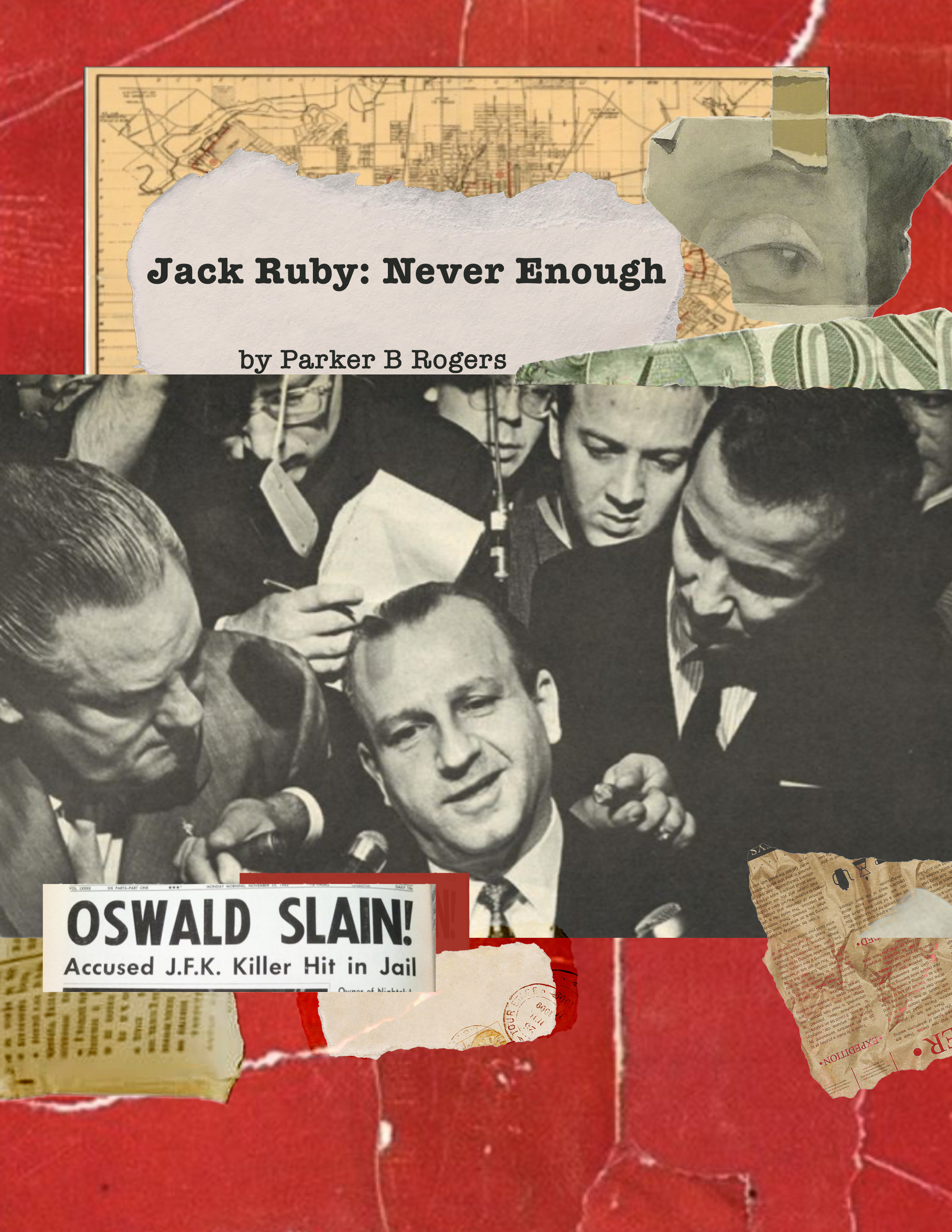
Written by Parker Rogers
Art by Parker Rogers
There is a bottomless well of information regarding the assassination of John F. Kennedy, the apprehension of Lee Harvey Oswald, and the messy way their lives intermingled. The source of the well is unknown, and someone else will show you how to lower the bucket into that water. Here, we encounter a different man. A man who took the well of history, and stacked beside it piles of explosives, before watching with bewildered eyes as it all was blown to bits.
Jack Ruby was born Jacob Rubenstein to a crowded Chicago family with a half dozen other siblings in 1911. His father was a violent alcoholic, and his mother was a schizophrenic who spent the last half of her life in an insane asylum.
When Jewish Social Services did an investigation on the home, they reported that Ruby, 11 at the time, was “an egocentric with a hair-trigger temper consumed by sex and street gangs.” By the time he was a teenager, he had established a reputation in Chicago as a street fighter, earning him the nickname “Sparky.” A large source of his aggression was that he never wanted people to view him as less than for being Jewish. So he took to swinging first, and swinging hard. Ruby carried big emotions and struggled to manage them. He found the best way to deal with his emotions was physically, as the social norms of the time frowned upon men expressing emotion.
Ruby left Chicago in 1933 to sell newspapers in San Francisco, an endeavor that did not pan out. He worked in Los Angeles as a singing waiter briefly before moving back to Chicago when his mother was committed to a mental institution. She was diagnosed as “a psycho neurosis with a marked anxiety state.”1 But honestly, who hasn’t had a tough weekend before? During this time, he was attempting to ‘go straight’ and began working in the Scrap Iron and Junk Handlers Union. His intentions were good.
When he was drafted into the Air Force in 1943, he did well there until a sergeant called him a “Jew bastard.” Upon hearing this, Ruby relentlessly beat the man. Aside from that, he did well during his time in the military and was well-liked.
After a failed business endeavor with his brother, Ruby moved to Dallas in 1947 to help his sister run a nightclub called The Singapore Supper Club.
His arrival in Dallas came with a name change: Jacob Rubenstein became Jack Leon Ruby. Ruby understood he had to brand himself, and his image was something he truly cared about. He considered himself a character, carrying around his pet dachshund named Shiba, telling people, “This is my wife.” Despite being well known around Dallas, he didn’t have many true friends at all. The people of Dallas considered Ruby to be insane, unpredictable, and overly emotional, which only got worse as the years went on.
Ruby loved being a part of the nightlife. He loved the glitz and the glamor, the connections it brought him around town, and more than anything, he loved the women, whom he both charmed and frightened. He was in the nightclub business for 16 years, owning interests in six clubs—all of which he lost money on but one, The Carousel. He encouraged the women who worked for him to flirt with the customers and hustle champagne bottles. He was terrible at running nightclubs, but he was fantastic at wanting to run them.
These failures tormented him. Ruby moved to Dallas in 1947, and within a few years had a mental breakdown and became suicidal. He quickly developed a reputation for being a highly emotional man. But he tried everything he could to make something of himself, selling sewing machines, costume jewelry, liquid vitamins, English razors, anti-arthritis medication, twist boards, and pizza ovens. But none of it went anywhere; by the time he killed Oswald, his debt would equate to $135,000 today.
One of the lawyers on his defense team said of the man: “[Ruby] was a real object of pity. Anytime you see a person overflowing with ambition to be someone, that person is admitting to you and the world that he’s a nobody.” 2
Even though things weren’t going well, Ruby took a lot of pride in The Carousel. He would call The Carousel “a real classy joint.” In reality, it was quite dingy. Despite that, he seemed to truly care about his employees. One of the women who worked for him said, “Jack had a soft heart. He was always loaning us money and knocking the snot out of anyone who gave us a bad name. He liked that image of himself—big bad protector. He’d fire you, then ten minutes later break in on you in the john and demand to know why you weren’t on the floor pushing drinks. One girl there got fired about three hundred times.”3
Ruby was always hustling the club. He’d make his rounds every day, hitting the bank, the Statler Hilton, the police station, the bail-bond office, the shoeshine parlor, the radio station. He would constantly be handing out passes to the club, shaking hands, and yapping in that quick Chicago beat. He also loved to go to boxing matches and, of course, brought a stack of passes with him when he went. He usually carried a big roll of money on him, and when he packed cash, he packed heat as well.
At one point, he invested in a nightclub act called Little Daddy Nelson. Little Daddy was a five-year-old boy who, between the dancing numbers, would do little jigs, dances, and tell racial jokes. After getting to know Little Daddy and his mother, Ruby expressed interest in adopting the boy. 4
Even though he took a lot of pride in his business, he wasn’t able to keep his emotions out of it. He’d invite someone to the club, then ban them the next moment. He threw people down the stairs, bashed liquor bottles over their heads, knocked a man’s teeth out, and fought dirty. He once severely beat a professional boxer. Ruby was a capable fighter and kept himself in good shape. However, often when he would explode into these bursts of rage, he wouldn’t remember it afterward. He also never drank or smoked. He was a starchily sober man. Given his major mood swings, some believe that Ruby was bipolar. While that is possible, what his autopsy revealed was a more compelling explanation for his behavior; namely, fifteen tumors in his brain. Either way, the man was the definition of unpredictable.
He was proud of the way he looked, walking around the dressing room shirtless, and thumping his chest like a gorilla. He’d call the women who worked for him later at night, asking what they thought of his body and describing his genitals to them.
In just 14 years, Ruby was arrested nine times and lost his liquor license twice. He was able to manage this, however, by serving the cops. He loved when cops would come drink at his club, and would give them free drinks to keep them around. Many would consider him to be a cop groupie, and he would snitch on anyone he could, as often as he could. This ostracized him from most of the criminal community within Dallas. The mob did frequent his club when they were in town, but this is often looked into too deeply. The mafia enjoyed nightclubs, but they were smart enough to keep Ruby at arm’s length. One of his closest friends, Joe Cavagnaro, put it well: “Nobody would have trusted Jack with a secret. He talked too much.”5
Hugh Anyesworth, a Times Herald reporter, verified: “In 1959, the FBI tried eight times to recruit Jack Ruby. They wanted him as an informer on drugs, gambling, and organized crime, but every time they contacted him, Ruby tried to get his competitors in trouble.” He had nothing but class.
Hanging on the wall of the nightclub was a framed portrait of John F. Kennedy, whom Ruby worshiped. Ruby believed that Kennedy was good for American Jews after he put quite a few Jewish men into positions of power.
When Kennedy was assassinated on November 22, 1963, it shocked the nation. You can find the details for this elsewhere; sources are more than abundant. JFK’s approval rating when he died was 58%, and most Americans were happy to have him in office. But for Ruby, who was an unstable, highly emotional individual with a Preludin problem (an appetite suppressant he used as an upper), it was catastrophic. He even went so far as to tell his sister that he was struggling more with the death of JFK than he had with their parents.
In the hours following the death of JFK, the country was in chaos. Ruby, despite being utterly distraught, began popping up in all these very important places. For many, this points to conspiracy, but I personally align with Hugh Anyesworth, Times Herald reporter, who not only witnessed the shooting but studied the case for twelve years. Anyesworth believes Ruby wouldn’t be capable of being involved in a conspiracy of this magnitude. “Ruby would have told everyone on the streets of downtown Dallas. ‘Ho, ho, ho, they asked me to kill the president. Of course, I’m not gonna do it.’”
Being incredibly familiar with the Dallas police and reporters, he went to the department where Oswald was being held. He went around spinning some yarn about how he was there to do some Yiddish translation for another detective, all the while shaking hands and passing out fliers for the Carousel. Even in this moment of deep mourning, he couldn’t pass up a promotional moment. Ruby was a known face in the department, so seeing him there wasn’t a shock to anyone, and the camera he wore around his neck didn’t hurt either. That day, Ruby caught a glimpse of Oswald and said the smirk on his face was all he needed to know that Oswald had done it. Ruby also went to Parkland Hospital, the assassination site, and various press conferences, making his face known and familiar where it counted.
That night back at the Carousel, Ruby drank heavily. For hours, he commented again and again on how terrible the whole thing was. Ruby simply couldn’t take the matter as anything but personal.
“There’s something [to be said] about this man that has now taken this onto himself because he believes he is an adopted son of Dallas. He loves Dallas. He feels for Dallas,” Henry Zebrowski, from Last Podcast on the Left, comments.
The next morning, Ruby woke up extremely hungover to a call from one of the women who worked for him, needing the money that he owed her. The Western Union office, where he was headed, was on the same block as the police station where they were holding Oswald. He wired the money over to her at 11:17 a.m., noticing the crowd as he left the bank.
He was carrying $2,000 in cash, which meant he also had his gun on him. He went around to the back of the police station, where the news crew was waiting for Oswald. Despite the police knowing that Oswald’s life was in danger, they didn’t do much to help him. They absolutely could have moved him in the middle of the night, but waited until the morning for the publicity. Not only that, but they were late in moving Oswald. Oswald had been cold and requested a sweater. Then he debated between the beige and the black, eventually choosing the latter. Had he not been so picky about this, or not requested the sweater at all, he may have been moved before Ruby ever finished wiring the money.
Many believe that the decision to kill Oswald was made the moment Ruby saw him. There was no real plan; it was mostly just opportunity. He walked over because there was a crowd, and he wanted to catch a glimpse of the man. With the gun in his hand, Ruby’s aggressive nature took hold of any rational thinking the man was capable of.
He cut through the crowd and jumped out in front. One of the detectives who knew Ruby screamed, “Jack, you son of a bitch, don’t!”
But it was too late; the wheels had been set in motion. Jack Ruby screamed, “You killed my president, you rat!” before shooting Lee Harvey Oswald at 11:20 a.m. with a .38 snub-nose revolver. Exactly three minutes after he had wired the money.
Ruby didn’t understand in the slightest why he was being arrested. He did not understand that he had made himself judge, jury, and executioner in his actions. Ruby thought he would be made a hero for what he’d done. When police officers tackled him, he wailed out, “I’m Jack Ruby! You all know me!”
America had just seen its first death on live television.
The trial was quick for Ruby. There were dozens of witnesses, as well as the footage of him killing Oswald. His defense team tried to plead that he was epileptic and having a seizure when it happened. He was originally sentenced to death, but that was later appealed.
Ruby didn’t handle his sentencing well, becoming delusional and depressed; he attempted suicide more than once. However, before a retrial could take place, Ruby died of cancer on January 3, 1967.
Studying Jack Ruby filled me with a well of empathy. A man who wanted nothing more than to make something of himself. He didn’t have the resources to manage his emotional issues. He was the type of person who never gave up on himself and kept trying, despite setbacks. He is the poster child of never becoming anything. Even now, the biggest thing he did, killing Lee Harvey Oswald, has been swept to a dusty corner of history.
Joe Tonahill, who was a part of Ruby’s legal team, said, “Jack Ruby needed help long before Kennedy came to Dallas. He was a big baby at birth–almost fifteen pounds. That could have had something to do with it.” Continuing that “[Ruby] had a long history of violent, antisocial behavior, and when it was over, he wouldn’t remember what he had done.”
That being said, Ruby was also a man who ruined history. Because of his actions, we will never have a clear answer on what happened to JFK. While Ruby was a man who suffered his entire life, and only suffered more in prison, he is still responsible for the destruction of his own life, as well as the mess he made of any clear narrative we may have had regarding the death of JFK. Yet still, had he chosen to act differently, his name would have been lost to the annals of history.
Sources:
“Commission Exhibit 1613.” Warren Commission Hearings, vol. 23, U.S. Government Printing Office, 1964, history-matters.com/archive/jfk/wc/wcvols/wh23/pdfto,/WH23_CE_1613.pdf
Cartwright, Gary. “Who Was Jack Ruby?” Texas Monthly, 1 Nov. 1975, www.texasmonthly.com/news-politics/who-was-jack-ruby/.
Science; on Epilepsy; Ruby Trial Focuses Attention on Seizures and Their Effects – The New York Times, www.nytimes.com/1964/03/15/archives/science-on-epilepsy-ruby-trial-focuses-attention-on-seizures-and.html.
Parks, Marcus, host. Zebrowski, Henry, host. Kissel, Ben, host. JFK/Lee Harvey Oswald Part IV – OSWALD!, Last Podcast Network, 7/3/2020, https://open.spotify.com/episode/1so7i5qMunvV4nUaLH6FqW“United States
Presidential Approval Rating.” Wikipedia, Wikimedia Foundation, 9 Sept. 2025, en.wikipedia.org/wiki/United_States_presidential_approval_rating
- Parks, Marcus, host. Zebrowski, Henry, host. Kissel, Ben, host. JFK/Lee Harvey Oswald Part IV – OSWALD!, Last Podcast Network, 7/3/2020, https://open.spotify.com/episode/1so7i5qMunvV4nUaLH6FqW ↩︎
- IBID ↩︎
- IBID ↩︎
- “Commission Exhibit 1613.” Warren Commission Hearings, vol. 23, U.S. Government Printing Office, 1964, history-matters.com/archive/jfk/wc/wcvols/wh23/pdfto,/WH23_CE_1613.pdf. ↩︎
- Cartwright, Gary. “Who Was Jack Ruby?” Texas Monthly, 1 Nov. 1975, http://www.texasmonthly.com/news-politics/who-was-jack-ruby/. ↩︎
You must be logged in to post a comment.