
Written by Audrey Orenstein
Art by Greta Scheff
If I had a nickel for every time a housemate informed me that a famous person had done something antisemitic, I’d have two nickels. In January, it was Elon Musk performing a Nazi salute and making Nazi jokes on Twitter—the only example of deadnaming I support—while in February, it was Kanye West going on yet another tirade against Jewish people on Twitter and selling swastika t-shirts via his clothing brand that later got that brand’s site taken down. Here’s hoping that March doesn’t solidify this as a new monthly tradition.
As a Jew, these events and their respective fallouts have made me feel angry, sad, and fearful in ways I’ve never quite known before. This negativity has manifested in my brain as a single, infuriatingly unanswerable question: to what extent do those that proudly align themselves with the Nazis wish to follow and are capable of following in their footsteps? It’s a sizable query in every way, from the myriad of factors it encompasses to the potentially dire consequences of the answer. Simply put, it haunts me.
But alongside the anger, sadness, and fear, all of this has led to a feeling of curiosity as well. While the latter emotion’s neutrality makes it the most positive one only by default, it’s still a mental breath of fresh air. Like its contemporaries, this curiosity has led to a question all its own: how did we get here? More specifically, how did I get here? While I cannot know the answer to the question posed above, I can find answers to the question of my ancestry. In this piece, I’ll aim to contextualize myself, potentially learning more about the world I fit into along the way.
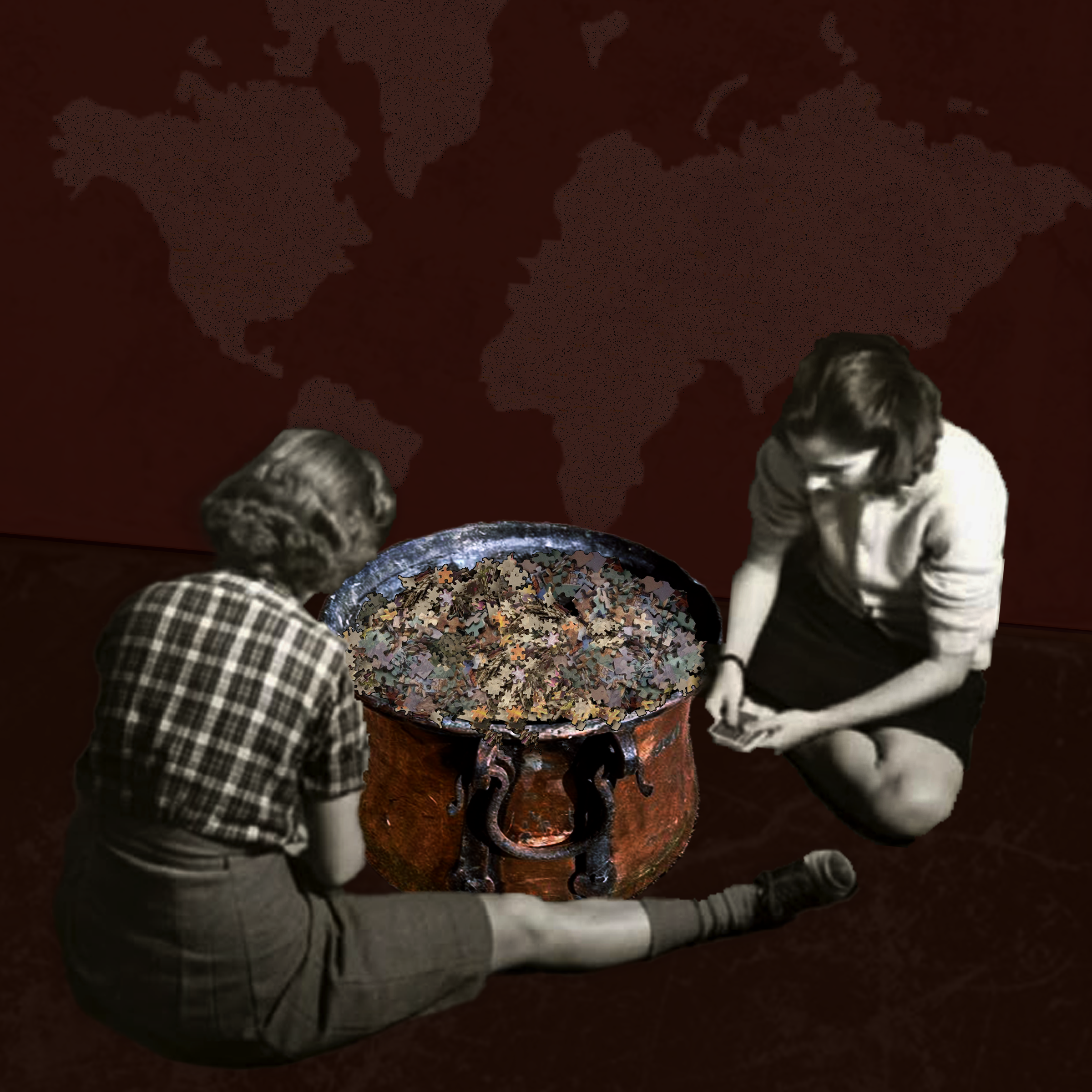
As far as I can recall, my first introduction to the concept of cultural identity came from a VHS tape containing “The Best of Schoolhouse Rock.” Specifically, it came from “The Great American Melting Pot,” a song about immigration to the United States. Even as a child, the tune always stood out to me as being particularly meaningful when compared to every other track on that tape. While all bangers in their own rights, they mostly just covered times tables, grammar rules, and historical events. In stark contrast, “The Great American Melting Pot” was primarily about people, with the eponymous dish being one within the Statue of Liberty’s “book of recipes.” It’s a beautiful and thought-provoking song, even to this day. While the term “melting pot” itself is outdated, the lyrics focus less on the associated concept of cultural homogeneity and more on the idea that anyone and everyone belongs in the United States. In many ways, despite its title, “The Great American Melting Pot” still arguably advocates for the more modern salad bowl analogy, which pushes for multiculturalism within a single nation. To me, this is made no more clear than in the following lines:
“Go on and ask your grandma,
Hear what she has to tell
How great to be American
And something else as well.”
The visual accompaniment to those lyrics is a grandmother waving a little American flag while displaying a button on her dress that reads “KISS ME I’M POLISH.” Watching this well before my age reached the double digits, I would see those words and recall that the country of Poland was somehow important in regard to my father’s side of the family, the source of my Jewish heritage. Despite a lack of details, I still felt connected to the song’s message in that I was the latest chapter in a very long story. Recently, I called up my father and my grandfather to figure out exactly how that story went.
Disclaimer: I’ll only be talking about members of my father’s side of the family for the remainder of this piece. After all, it would be a real hassle to add “on my father’s side” as a prefix to every member mentioned!
Sure enough, my grandmother’s parents were born and raised in Poland. It was the early 20th century, a bad time to be Jewish in Europe. Antisemitic governments restricted a Jew’s ability to learn, work, and own property, among other things. As such, the two of them made their way from Poland to Cuba and then to New York. My great grandfather was a butcher while my great grandmother worked in a sweatshop, sewing sleeves onto coats. If you’re wondering why the dates aren’t more concrete, it may be worth noting that they didn’t make their way into the United States legally. As such, my great grandfather was eventually caught by authorities. But as he was about to be interrogated, he told his captors that he had to wash his hands. Once inside the bathroom, he simply opened the window and jumped outside, escaping the long arm of the law! After that, he and my great grandmother went to Canada upon hearing that there was someone there who could get them the papers they needed. This ended up working out, with my grandmother being safely born on American soil.
In the same time span and for the same reasons as my grandmother’s parents, my grandfather’s grandfather immigrated from Austria to America by himself. Once he arrived, he worked for 80 hours a week to save up money for the rest of his family to make the trip. By 1911, he had done just that, resulting in my great grandfather crossing the Atlantic at the age of two. Along with his mother and two siblings, he travelled in steerage class, the figurative and literal lowest class aboard the ship. A lack of food and air was made up for with an overabundance of rats and sickness, leading to many immigrants dying before reaching America. Fortunately, my ancestors were among those that made it, becoming US citizens through Ellis Island after symbolically passing the Statue of Liberty.
At one point in “The Great American Melting Pot,” the lyrics—which are sung by Jewish singer-songwriter Lori Lieberman—describes how immigrants “brought the country’s customs, their language and their ways.” As it turns out, this very much applied to my great grandparents, particularly my grandmother’s parents. In terms of language, they spoke both Polish and Yiddish. My grandmother was fluent in both Yiddish and English, the latter of which she learned from an institution that taught immigrants—particularly Jewish ones—things they’d need to know in the United States. There were also plenty of Polish customs that made their way across the pond. For example, after my grandparents got married, my grandmother was expected to cook dinner for my grandfather by five o’clock. If that didn’t happen, her mother would yell at her! But the most prominent ways of life they brought with them were those of Judaism, ways that have lasted for generations.
With that said, my grandparents were never quite as religious as their parents, with a key reason being my grandmother’s distaste for the sex-based segregation in synagogues at the time. As a result, my family’s definition of what it meant to be Jewish evolved, becoming less strict while still observing the most important holidays and traditions. My father’s own interactions with his religion boiled down to Hebrew school a few times a week, attending the occasional service, and the usual Bar Mitzvah at age thirteen—of which he remembers caring mostly about the money and party that would accompany the ritual. At the time, Judaism felt like more of an obligation than anything else. However, it was at that party that he gained an appreciation for his stereotypically big Jewish family, seeing relatives come from all over to celebrate the religion that bound them all together.
When I was born, my parents agreed that I should be raised as a Jew so that I’d have the opportunity to be a part of that community. From there, my religious upbringing was more or less identical to my father’s, right down to the sense of obligation that persisted within me for a while. But just like him, I grew to appreciate my Jewish heritage as I began to understand the role it played in building a sense of familial community. Every Bar or Bat Mitzvah was a chance for everyone to get together and talk. For the longest time, we’d all get together every year for Thanksgiving, leading to a lot of treasured memories. I’ll never forget adding my voice to a chorus of aunts, uncles, and cousins mocking the Jeopardy contestant that got a question about Yiddish wrong!
That’s more or less how I got here. The process of connecting myself to all of these different people was a powerful and moving experience. Unfortunately, that power lends itself well to a double-edged sword. On the one hand, it inspires me to think about how much my life has been shaped by being a part of this giant Jewish family. On the other hand, it’s exceedingly difficult to disconnect all of those aspects of Judaism from the oppression that’s historically met them. This is where Elon Musk and Kanye West come in, implying a desire for ^tendency of^ history to repeat itself.
“You simply melt right in,
It doesn’t matter what your skin.
It doesn’t matter where you’re from,
Or your religion, you jump right in
To the great American melting pot.”
Released in 1976 as part of America’s bicentennial celebrations, “The Great American Melting Pot” reinforced the idea that everyone has a place on the list of ingredients that make up the nation. How sad it is that nearly fifty years later, rich and powerful people are leveraging their wealth and influence to enforce dietary restrictions. In many ways, the idea of being “American and something else as well” feels sadly outdated. Countless bigoted bills and egregious executive orders seek to define an American as someone who isn’t something else as well, with the list of what qualifies as “something else” growing longer and longer. According to many of the people in charge, being a transgender Jew makes me less of an American than Elon Musk, the man who referenced the regime which would’ve seen me as less of a human being. The man who is, himself, an immigrant!
“Lovely Lady Liberty
With her book of recipes
And the finest one she’s got
Is the great American melting pot”
In 1883, funding to build the Statue of Liberty was coming up short. As part of an effort to raise money, various artists and writers were asked to create art to be sold at auction, with the proceeds going towards the project. One of those writers was a poet named Emma Lazurus. Her contribution was “The New Colossus,” the most famous excerpt from which I’ve pasted below:
“‘Give me your tired, your poor,
Your huddled masses yearning to breathe free,
The wretched refuse of your teeming shore.
Send these, the homeless, tempest-tost to me,
I lift my lamp beside the golden door!’”
You wanna know something cool?
Emma Lazurus was Jewish!
Think about it: a Jewish poet wrote about a statue that my Jewish ancestors saw as they arrived in their new home, a statue that was prominently featured in the music video for “The Great American Melting Pot,” which was sung by a Jewish artist and greatly enjoyed by my Jewish self!
But those aren’t the only connections to be made. In the same way that Judaism ties people together, it ties those people to their history. We would’ve been killed in the Holocaust, which Elon Musk jokes about. We would’ve been slaves in Egypt, which Kanye West likes the sound of. I shudder to consider what we’ll be in the future.
With that said, however, it’s very much worth keeping in mind that the fear instilled in me by bigots is prompted by the fear that bigots have of me. It scares me to be painted as un-American, but it scares them that I am an American: a neurodivergent American, a transgender American, and a Jewish American! No matter how somethings else as well we are, we’re all still endowed with the unalienable rights to life, liberty, and the pursuit of happiness.