
Written by Sarah Chack
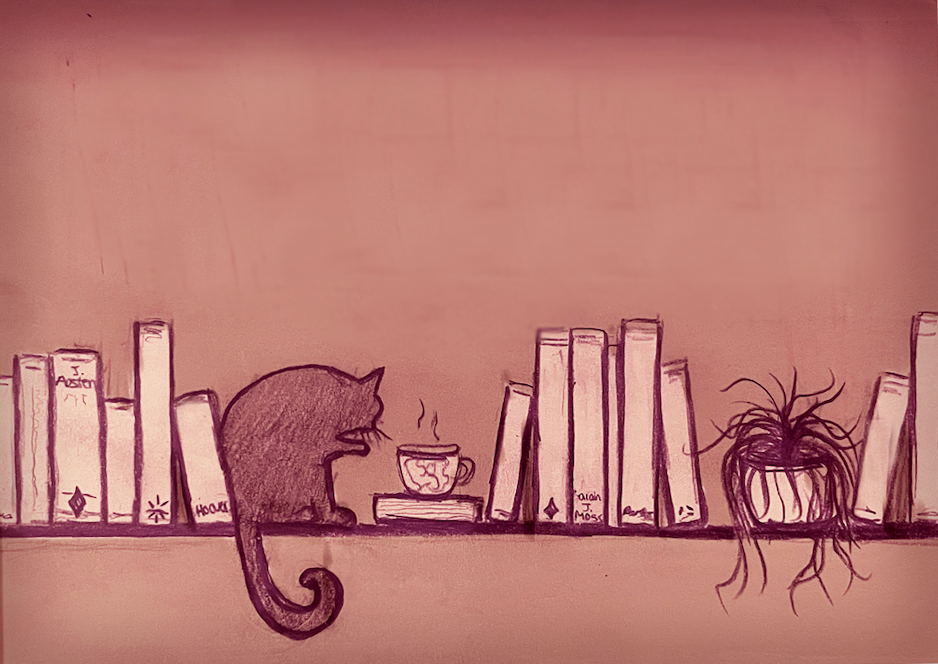
Art by Greta Scheff
The shelves are packed with books from Suzanne Collins to Jane Austen. The library is nearly empty; the only noise comes from a collection of high school seniors that idle in one of the aisles, killing time between their classes. They huddle around the “H” authors in the section, like desert explorers finding water for the first time in days. A big, red sign hangs over them and the seven letters written on it curl into one another to spell out one word: ROMANCE.
Colleen Hoover’s books have gained a level of notoriety among young women in recent years due to “booktokers” doling out raving reviews of her novels. They find her work easy to read, accessible, and brimming with the rare potential to get them out of a reading slump. Yet, young women are not the only demographic reading Hoover’s books; many of her dedicated readers are high school girls. Out of all of the high schoolers reading Hoover’s work, those who are easily influenced by social media and the words of their friends are at the top of the list; a topic for classroom side-chatter has never been this easy. When everyone is talking about it, might as well succumb to the pressure and read the next best thing since bagged bread: It Ends With Us.
If you aren’t familiar with Hoover’s works, here’s the basic rundown: boy (as possessive as he is controlling) meets girl (demure, shy, and All-American), they fall in love, and girl lets boy do whatever he wants with the promise of always forgiving him. No questions asked. Ever. She gets to be with the deep, dark, and traumatized boy. He gets to do as he pleases for all of eternity. Happily ever after.
While discussions of abusive relationships should be more frequent in the lives of young adults, we don’t tend to teach young women what these relationships look like, or how to navigate them. Instead, we hope that they’ll figure out what abuse looks like through trial and error and a little bit of pain, or die trying. This isn’t to say that Hoover shies away from writing about abusive relationships, far from it, and her bringing awareness to the topic is important. The issue lies in the fact that Hoover’s writing tends to glorify, and even romanticize, the trauma that her protagonists go through at the hands of their partners—creating a coloring book based on the plot also doesn’t help, even if it was supposedly well intentioned. This glorification becomes another piece of the ongoing narrative that abuse is normal—that experiencing it is desirable.
This doesn’t bode well for young women attempting to figure out their own relationships, much less so for the girls who are still in high school. Even if there isn’t a distinct correlation between Hoover and the number of abusive relationships women have been in since her first publication, her work still teaches the following, seemingly infallible principle: women should be abused by their partners because that’s just what love has always been.
The issue—aside from the troubling message being mainstream in the first place—is that in young minds, this idea seems to stick; it wedges itself just between “breakfast is in the morning” and “I have field hockey practice after school.” At this point in their lives, high school girls are getting their first boyfriends and attempting to understand the complicated thing that is love. In fact, much of the pre-class gossip that I’ve witnessed has been about who’s with who, and the drama that comes along with it; they talk about dates to the gas station down the road from school and the longing stares that are thrown across the classroom during their midterms. The truth of the matter is that high school girls are fascinated by love, or at least their idea of it; they’ll follow any guide that claims to help them understand it better, even if it’s wrong.
These girls are learning who they are; they’re attempting to figure out what they want in a world that tells them what they should want. Yet never, in all this searching, do they think that going through a million “break-ups” and “get-back-togethers” in the span of a month is anything other than normal. If anything, they think that this cycle shows that their relationship is real; that it’s adult. They’ll graduate knowing that the Pythagorean Theorem is a2 + b2 = c2, but not that real love is separate from abuse.
But there’s more to think about than just Hoover’s romantic messaging for young women. While her writing is rudimentary at best, tackling topics like abuse poorly, it also does the unthinkable; it gets non-readers to read. High school students, now especially, are reluctant readers. This is a simple fact, one that I’ve seen direct evidence of in my time as a student teacher. The students in my classes have difficulty getting through even the shortest graphic novels for their choice books, and it becomes difficult to imagine them reading even a quarter of what we consider to be the “classics.”
It doesn’t help that reading scores are at the lowest that they’ve been in years, and many students are unable to read anywhere near grade level. While experts state that the pandemic has exponentially worsened literacy levels, it isn’t the only culprit; students are being taught mixed messages about the importance of reading comprehension. Teachers try to stress the importance of reading, but it’s difficult when the allure of social media is dangled just out of reach.
“What’s the point in continuing to become book-literate when media literacy is much more prominent in our daily lives- focus on one, not both,” social media says to the dismay of teachers everywhere. The thing is that students are capable of reading—the students I see throughout the week read their text messages, understand the nuances of internet culture, and create new words faster than I could read them—but the value of traditional literacy is no longer there. It’s been battling against technological literacy for years now. And, in a world of technology, the latter tends to win.
Moreover, many students think that books are too long, that they aren’t interesting, or—the most frequent offender—that they don’t seem all that relevant to their own lives. There is always a groan of dismay whenever the students in my classes see the dreaded words on the daily agenda: silent reading. They equate books with school, and are unable to distinguish reading for pleasure and reading for work. They wonder: why should I have to read about a bunch of boys on some random, middle-of-nowhere island when I can’t even drive at night? And yet, these same students are so incredibly attached to the work of Colleen Hoover and others like her, to these stories that they themselves have most likely not fully experienced.
Part of this, I believe, is empathy. Many young women can empathize with the situation
of the main character: a shitty boyfriend who found every conceivable way to make his dirty dish your fault. They understand what that feels like, even if the dirty dishes in their own story were dirty sneakers, or if the shitty boyfriend was a shitty best friend. Conversely, they find it difficult to empathize with a socialite partaking in elaborate parties during the Jazz Age; it doesn’t seem relevant to their own lives. Rightfully so, might I add.
Young women are not given the opportunity to read stories about characters that they seem to understand on a deeper level. Because, even if these characters are older and have lived vastly different lives, they understand what it means to be a woman in the modern age better than the characters in the required reading of schools: pages upon pages filled with every thought and feeling that old white men have had since the beginning of time.
Yet there are plenty of other authors that discuss abusive relationships without glorifying them. So why is it that young women are gravitating towards Colleen Hoover?
Maybe it’s the readability of her works, the accessibility of hard topics that she seems to give struggling readers who wouldn’t be able to learn about them elsewhere. Maybe it’s her astounding ability—or, at the very least, her valiant attempt—to make shitty men seem sexy. Or maybe, it’s the fact that we read about what we think we deserve; women have always been taught that love hurts.
As worried as her writing makes us, we have to admit that Hoover has stirred up a conversation that should have happened a long time ago; she’s made us all start to wonder if what we’ve been taught about love is correct. Maybe it didn’t start with her, but maybe, just maybe, our complicity ends with Colleen Hoover.