
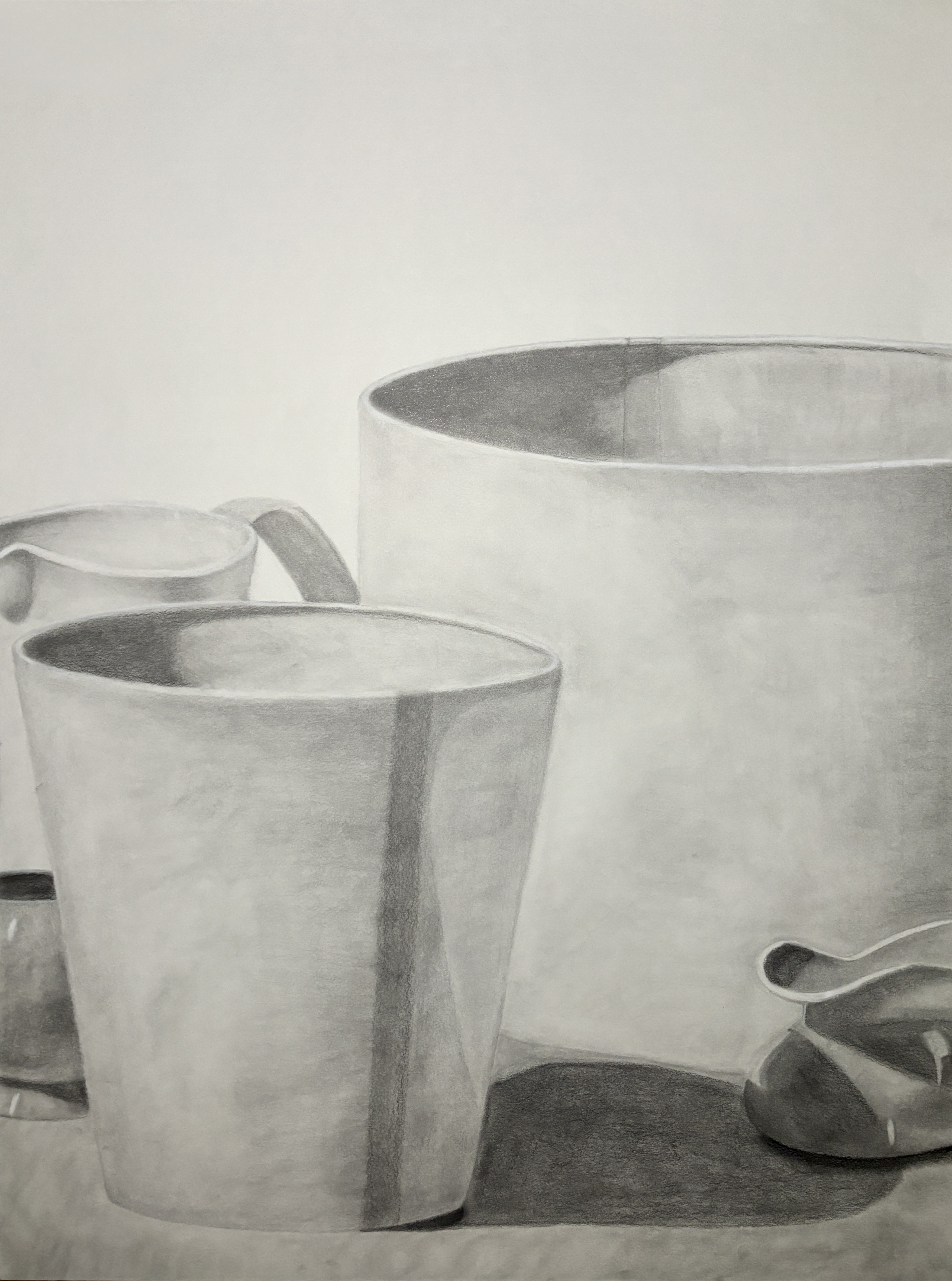
Written by the Chivomengro Staff
Art by Yana Ramos
HUNTER
There is a memory of rich red clay. I sat in the third row of a green Ford Expedition. I could not have been older than six. My dad was driving, and my four older brothers were excited. I was on the outside of their joy, looking in, since they were so much older than I.
We were driving down a dirt road headed to a red clay quarry. The Alabama sun cast a heat haze, making those red walls seem to dance. Even now, twenty-something years later, I still think of those quarry walls when I see a heat haze.
The quarry was vacant and inactive. No machines were waiting for the next workday, and no piles were waiting to be hauled. Instead, it was full in its emptiness. We were here to interrupt that emptiness.
Dad brought us here with packs of orange earplugs to participate in a classic southern tradition: shooting targets.
He must have repeated his commandments then, as I have heard him do countless times since. Only point it at the target, do not put your finger in the well until you are ready to shoot, only point at the target, do not flinch, only point at the target, shoot when you breathe out, and only point at the target.
I would be lying if I said I remember every detail of this day. I don’t even remember what gun they used. But I remember that I was not allowed to shoot, because I was too young. I remember walking around the clay pit and looking for things in the dirt. I remember that my brothers were hooting and hollering. I remember the sound of gunshots reverberating off the clay walls.
While they worked on their marksmanship, I did what I was so good at as a child—I made a mess. Digging in the rich red clay, looking for rocks or treasures. The state of filth I reached surely landed my dad in trouble when we got back to Mom in our double-wide trailer. Red clay was smeared over my clothes, coating my white shoes, and sitting under my fingernails.
I know my brothers as adults, but in this memory, I see them as boys, excited to share an experience with their father in a pit of red clay. I see them happy. I hear their joy between pops. Last April, for the first time in over a decade, all of my brothers were together in the same place. My grandfather had just passed away. We understood our bonds better in that clay pit, where joy connected us, and not sorrow.
I have often wondered but never thought to ask if that pit is still there. I like to think that it remains as a silent observer to memories that it will outlive.
LUTE

“One-Hundred Shards”

when you break
your favorite cup
it will shatter
into one-hundred shards

molded from cold, wet earth
and hardened in fire
ceramic on a shelf
grows a film of dust and cold
held down by its own weight

and waiting to be held
by a gentle hand
or waiting to be dropped
to crack and chip
they all shatter

no matter how loved
or unloved,
how used or unused
no matter how many layered
stains and streaks
of coffee and tea
they come to know
no matter how many spirals
have been stirred into them

they all break into
one-hundred shards
that clink and clatter
drawing blood and swears
one-hundred shards
of your favorite cup

thrown away
will soften and crumble
in the moisture and sun
until,
they gather back
into cold earth
again and again
until,

you can no longer have
a favorite cup to break
until,
you soften and crumble
into cold earth

waiting to become a delicate thing
again,
to be shattered
by carelessness
or by love
ABI
Are we our own person? Or are we an amalgamation of everyone we’ve ever loved or had a close connection with?
Sitting in my bed, candlelight flickering, lighting up the incense smoke, while I listen to Jeff Buckley and think about clay; a very casual Sunday night in Burlington, Vermont. Many ideas swirl through my head, like the smoke in my room, but they blow away before I get a grasp on them.
I like to think people are little lumps of clay on the dizzying throwing wheel called life. As children, we are full of potential, we are vulnerable, our brains are malleable, and we soak up influence and inspiration like sponges, like clay. People, adults and children, come into our lives, put their hands in our clay to shape us. They knead and add water until we are pliable enough to work with. They turn us on this wheel and build us up, leaving their impression. They have full control of us. They control the speed of the wheel, the amount of water, what to add, and what to take away. They can slip and they can score. They have the option to walk away, but regardless of whether they do or not, they have left their mark on us. A thumbprint on our side or the form of their hand that helped shape us into who we are today. Some may stay longer, work with us, love us, and others are just passersby. They’re just as fleeting as the thoughts in my head tonight.
As time goes by, we start to toughen up. When kneaded too much, when left out to dry, we are harder to work with, but an experienced potter will know how to handle us. Will they let us dry so we can be glazed and fired? Or will they rehydrate us to then throw us back on that dizzying circle? We learn who can be trusted and become more finicky, more selective. We learn that it matters who we let handle us.
I like to think that we start as these little lumps of clay and we don’t truly come into our full form of either a mug, or vase, or any other ceramic knick-knack until our 30s. From birth to our teens, we are on the throwing wheel as these balls of clay, being worked with and shaped into the adults we will be one day. In our 20s, I see us as ceramics drying, waiting to either be glazed or fired. We are all at different stages of our lives, still figuring ourselves out, but we have a solid foundation, a solid base of who we are. Some of us will be glazed and fired before others because we are busy choosing our glaze colors, whether we want a matte or glossy finish, or if we should add more decoration.
By the time we reach our 30s, most of us have been glazed and fired. We are in our final form. We are in our strongest, yet most fragile form. There is still much that can be done to us. We will develop chips and cracks, stains from tea or coffee, or weird watermarks, but we will always be us.
I feel as though I’m on the throwing wheel. Burlington is my throwing wheel, and I’m getting nauseous; I’m almost ready to get off. I’m still being built up. I’m still learning who I am. So many have left their marks on me. I have my mother’s anxious and worrisome tendencies, my father’s critical and realist view of the world, my childhood best friend’s humor, my grandmother’s anal retentive cleaning, and my college roomates’ knowledge of when to not care and just let go. I like to wonder where all these people got these traits that they have passed down to me. I want to know who shaped and molded them.
I am my own person because I’ve been surrounded by a vast variety of different people my whole life, just like everyone else. We are amalgamations of everyone who has loved and connected with us, and that’s what makes us special and unique.
GRETA

Press, then dig, until your fingernails crust to your knuckles
Filled with dirt from my
Lack of soap

The epidermis which is my own
Has become an extension
of yours

Skin as stiff as stone
Cemented in our shared
sediment

Pull me
Apart if you can
And you will watch it
All crack, all that is me, or maybe
you’ll shut your eyes

Would you try concealing the faults if you could? I suggest using fresh
Clay—slip
You’ll mark, score
Make note of each crosshatch

Temperature reaches that Degree
Under which I split—the pressure,
Like brittle flakes of paint off that old wall

Were I not broken, I would tell you
It was doomed from conception;
An improper application of the
first coat.