
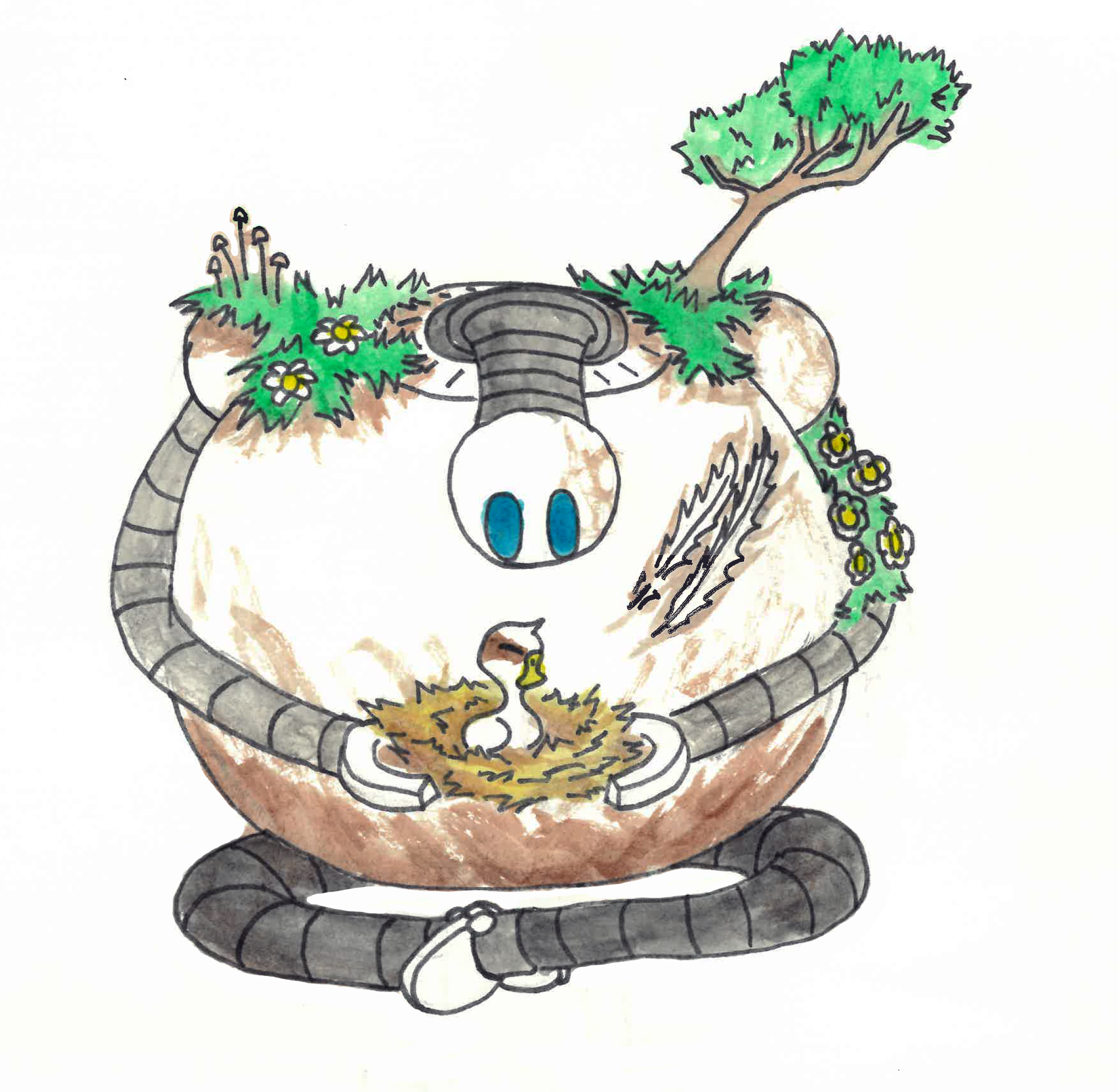
Written by Jordan Coolbeth
Art by Christopher Chapman
WARNING: This review WILL contain spoilers for the film, The Wild Robot, and the book series it is based on.
My mom worked as a children’s librarian for several years. During this time, a new bestselling chapter book was released, The Wild Robot. The main character is Roz, a helpful robot who washed up alone on an island after the cargo ship bringing her to her new job sank at sea. She struggles to adapt, and in a freak accident, kills a small family of geese, leaving only one egg intact. Upon hatching, the gosling imprints on Roz and she decides to raise him as her own.
This book was recently adapted into an animated film by Dreamworks. The film was released on Friday, September 27th, the day my mom planned to visit me at college. My mom had read the book previously and was excited to see how the movie compared to the original. I saw the art in the ads and was excited to see how beautiful the complete film was, so we went to see it together.
By Sunday, September 29th, I had finished the first book in the Wild Robot series and purchased the second.
The Art
The opening scene is gorgeous—and very accurate to the book. We see some scrap metal and packaging washed up on some rocks. A family of otters looks around curiously. The image seems warped around the edges of the camera. It’s quickly revealed that we are viewing this scene through one of the lenses that covers Roz’s eyes. The otters investigate this new robot curiously. In the process, they hit a button on the back of her head, her power button. Roz is unleashed on the island.
The art in this film is beautiful, and the opening scene shows viewers exactly what to expect from the rest of the film. The painted style is similar to the one seen in Puss and Boots: The Last Wish. It’s still a 3D film, but every texture and background appears hand-painted. The care put into every frame also reminded me of Spider-Man: Into the Spider-Verse, where every frame looks intentional and you can pause at almost any spot and find a beautiful work of art.
One of my favorite aspects of the art is how the style of the plants and animals differs from Roz and the other robots seen later in the film. Every plant looks hand-painted, as do the rocks and water. The textures of the animals’ fur and scales look similarly hand-drawn. Roz however, being a robot, is much smoother, and has much simpler textures. It isn’t until she gets damaged or covered in dirt and leaves that we see the painted texture of her body.
The difference is even more extreme when we see the full city for the first time. Everything is smooth and ‘perfect,’ both the robots and the buildings they maintain. The people have perfectly smooth hair and clothes. Even the hills behind the city are cell-shaded. Only the plants on the farm maintain that painted texture.
This difference between the painted and smooth shading styles is used throughout the film to show how Roz becomes wild. She begins perfectly clean and shiny, just like the other robots. As she becomes more damaged, dirt and scratches build up on her body, bringing some of the painted texture of the land onto Roz. When she loses her foot in the lake, it’s replaced with a log. When she shuts down for the winter, moss covers her body. By the time Roz leaves the island, she is completely covered in painted textures, just like the animals.
One interesting challenge the animators must have had with this movie was how to handle the darker aspects of trying to make wild animals get along. The book explicitly describes the brutality during the winter scenes, “…sometimes a lodger would return in the belly of another lodger.” In the very first scene, Roz crushes an entire family of geese, which is how she ends up adopting Brightbeak. The animators were careful to not show the entirety of these more gruesome scenes and often integrated them with the more humorous events. It’s honest about the fact that these are wild animals that kill each other frequently, but it refrains from making the film too dark or gory. The most we see is a bird being snatched out of the air, or a fox eating a crab.
The Voice Acting
I watched ads for this movie before it came out, and one of the complaints I constantly saw in the comments was that they had the animals talk. Some people thought it would be better as a mostly silent film, and refused to watch it because it didn’t meet their expectations. I decided to go into the theater with an open mind anyway and was pleasantly surprised.
The writers couldn’t have made this film as moving and meaningful as it was if the characters were silent the entire time. One of the key differences between Roz, Brightbeak, and the rest of the animals is how they talk. Roz is a robot, so she talks strangely. She sees the world differently, so she explains it differently. Brightbeak learned to talk from her, and is bullied by the other geese because of it.
It’s important to remember, this film is an adaptation of an existing book. Filmmakers can change minor details (as long as the heart of the story remains the same), but having the entire film be silent would cut out all of the author’s details about machine learning and how Roz learned the language of animals. It would remove many of the comparisons between programming and instincts, which was the entire reason the author wrote the book.
The voices in this film were fairly well done. There was never a moment where I looked at Fink and thought, “Oh, it’s Pedro Pascal.” Admittedly, I’m not particularly familiar with his movies and probably wouldn’t have recognized him either way, but the voice acting made sense for the character. I never felt like a character’s voice didn’t match their design or personality.
I also love how the film explains how Roz understands the animals. There’s a great scene, taken directly from the book, where she camouflages herself and spends days watching the animals. We see the entire scene through her eyes with notes about what the animals are saying. Over time, the language switches from unknown characters to English letters as Roz learns the animals’ language. How she learns is explained in much more detail in the books, and there were some details about Roz learning to camouflage herself that I didn’t understand until reading it, but I still understood just from the film that Roz was using patterns and context to translate the language.
The Story
Roz starts extremely confused, and I love it. She’s a robot with one goal: find the person who ordered her and receive a task. There are no people, however, so she asks every single animal on the island instead and nearly gets killed multiple times. It’s a great fish out of water story, but with a robot main character who just woke up and has no idea how the world works.
Roz, however, is a learning robot, so throughout the story she becomes more comfortable on the island and begins to act more like a living being. She starts out not understanding concepts like made-up stories and emotions. When Brightbeak leaves for the winter, she’s sad to see him go. By the end of the film, she uses a story to comfort him about her leaving. She goes through a complete character arch, even though she’s supposedly an unfeeling machine. It doesn’t seem like it should be possible—machines can’t change—but she does anyway. It differentiates her from the rest of the robots in the film.
The characters in this film and the stories they live through appeal to both confused parents and people who feel like they don’t belong. Roz is a robot attempting to learn to be a mother. She has to rewrite her own programming in order to be what Brightbeak needs in a parent. Brightbeak is a bird raised by a robot. He doesn’t fit in and has to learn to be more than what people expect him to be. It’s a beautiful story, and everyone can find a character they can relate to.
The Book
The film is amazing. It follows the key plot points of the book fairly closely and tells a heartwarming story in the process. There are, however, many differences between the book and the movie. The film is a story of belonging. It’s a story about learning who we are and how we fit into our world. The book is a story about the similarities between instincts and programming.
Brightbeak is not shunned by the flock in the book the same way he is in the film. He’s named by a mother goose in the flock and learns to swim alongside her ducklings. In the film, he’s named by Roz and struggles to swim alone. In the book, Roz is accepted by the animals far faster than she is in the film and receives advice from several of them. In the film, she is only helped by Fink. They are strange, but they are accepted by the island.
The version of the book I read includes a note from the author in the last pages. This entire story was inspired by the author’s fascination with robots and how they think. Robots are predictable. They’re programmable. A Roomba does not need to learn to clean, it just does. Animals are similarly predictable. They have instincts. They run from danger, they build nests. What happens when a robot has no human instructions, only animals? What will it do?
That’s the story the book tells. It’s not about how different Roz is from the animals, it’s about how similar they are. It repeatedly compares instincts to programming. Roz learns from the animals, she mimics them, and, eventually, she becomes one of them. She becomes a wild robot.