
Written by Sarah Chack
Art by Hadley-Rae Balmes
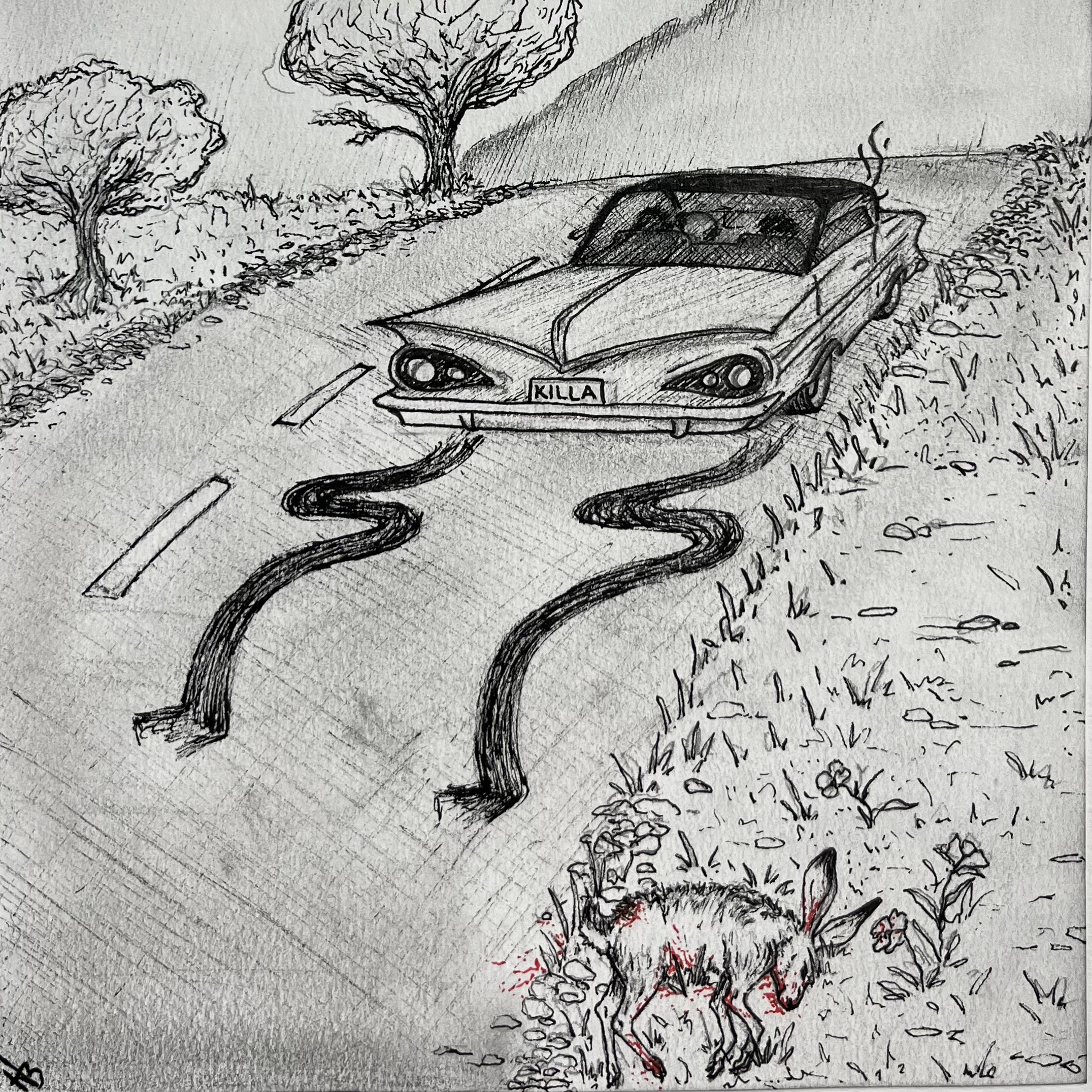
There was another dead animal in the road this morning. Two more appeared on the way home from my last day of student teaching. Maybe it’s the arrival of spring and the melting of the salt-filled road slush that’s drawn out the forest’s animals. Maybe they’ve come to see the strange animals that have taken over their once-abundant lands — their once-green pastures that are now oil-soaked and barren. Regardless, they appear, again and again, only to be taken by the shiny, metal beasts that move faster than they can blink.
I can’t help but wonder why we, as a society, care so little for the smallest among us; roadkill is the most common death in almost a third of all species, and yet it’s rarely talked about. We are content to continue onwards, simply swerving ever so slightly to avoid the viscera without ever looking back. Sometimes though, we risk a glance in that rearview mirror — the smallest flicker of eyes upwards as our fingers tap out some nonsensical beat. Our gaze lands on an insignificant pile of fur and flesh and bone in the middle of the road — it disappears under the tires of the next car as we continue on our way.
And then the next day, driving on the same road with the same Chappell Roan song playing, that dead animal is gone — it’s disappeared into some unknown dimension, never to be seen again. Where do the animals go when they no longer clutter our roads? Do they reanimate themselves and walk back into the forest just to repeat the process once more? Or are they pushed off the road by the plows and tires that make their rounds each day? I’m not quite sure if there’s one consistent process at the site of each casualty, but there must be some kind of similarity between them all — something that binds them to one another. Take Vermont, for example; here, humanity pushes roadkill into the woods to clear up space for itself — we do not care about laying the animals to rest. Predators then circle overhead, waiting to pick apart the dying animals that have been tossed into the treeline to fend for themselves. Their weak and feeble paws stop fighting as soon as their bodies hit the ground.
In some cases, the roadkill is salvaged, if it can be considered that, and donated to those who will make use of these once-alive animals. I imagine that, aside from the standard usage of meat, the roadkill is taken in by amateur taxidermists. Their stores are filled with decades — because no taxidermist is under sixty years old — of beloved pets and highway casualties that have been poorly transformed into a shitty attempt at preservation. And they are shitty. The fur is stretched oddly and their extremities rest at strangely human angles. But somehow this horrible taxidermy art is the best you’ve ever seen simply because it’s so horrible; we cannot quite stuff the look of vitality that comes with life into dead things, but we still try regardless. This is a way of honoring these animals, of caring for them after they’ve died at the deer catcher-covered front of a rusty pick-up with an eagle and flag decal covering its back window.
And what about the worms that appear after the rain (one of the editors of this magazine reminds me)? Are they not considered roadkill too? Are they not worthy of our love and care and grief? Where are their taxidermied bodies? They wash onto our streets and become stranded — they are left to be run over by cars and stepped on by the hundreds of Doc Martens worn on this campus. I think there is something to be said about how easy it is to ignore them: the worms and the roadkill. We continue pushing on because we have to. Because if we were to truly stop and think about these casualties — the ones that we have created with our own hands, our own shoes, our own pickup trucks — the suffering would be unbearable. Taxidermy is our way of attempting to rectify the deaths that we have caused.
Regardless, I haven’t seen another dead animal on the road since. Perhaps they’ve learned to stay far away from humans. Or, perhaps, they’re waiting in the lands just beyond our roads, hoping that those strange metal beasts have disappeared for good — they’ll peek their heads out next winter only for the cycle to repeat itself once more.